
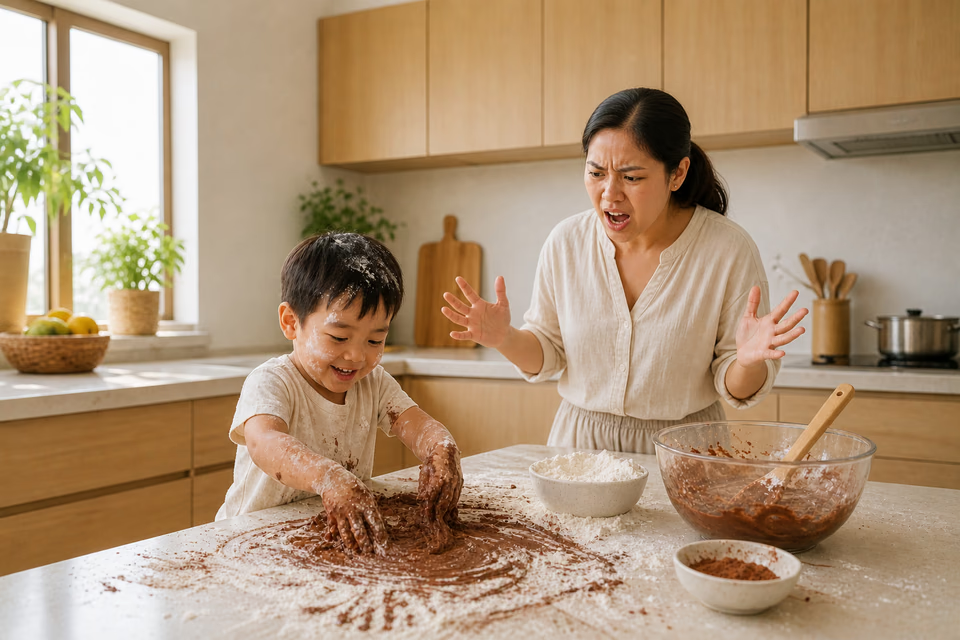
You know the moment. The rice leaves the tray, the yoghurt meets the floor, and something in your chest tightens before you have even decided how to react. If watching your child make a mess makes you genuinely uncomfortable, you are a perfectly normal adult.
We talk a lot about why sensory play matters for children. Less often about why it can be hard for us. These are reflections from our perspective as parents, not a psychological explanation of every adult's reaction.
Order and control
Part of it is workload. Someone has to clean it up, and that someone is usually you. But the discomfort can arrive before you have stopped to consider how much cleaning is actually involved. A few grains of rice take ten seconds to sweep up, yet they can still feel like an emergency.
Mess also touches our sense of order and control. A tidy room is one part of the day that is going to plan. Watching it come undone, deliberately and gleefully, at the hands of a small person you are responsible for, can feel like the rest of the day is about to go the same way.
We were once told off for this too
Some of us remember hearing “don’t touch that”, “you’re making a mess”, “look at the state of you”. If that sounds familiar, it may be useful to reflect on the expectations you grew up with. Other days, the explanation might simply be tiredness and one more thing to clean.
Noticing what feels difficult may help you pause. It does not mean you should be able to switch off a strong reaction just by understanding it.
What the mess looks like from their side
To your child, the moment is an investigation. The tipping, smearing and scattering are tests: what happens when I pour from higher up? What does this feel like on my whole hand?
The mess is still real, and so is the learning happening inside it.
Give the mess a place and a time
Boundaries make mess far easier to relax about: a designated tray or mat, one messy material at a time, clothes that are allowed to be ruined, and a clean-up routine your child helps with.
Give the mess a place and a time limit, and you can say a wholehearted yes inside them. “The rice stays on the sheet” is kinder on everyone than a vague, anxious “be careful”.
And when you need a day off
Some days you simply don’t have it in you, and that is fine too. It is one of the reasons our sessions exist: the mess is planned for, contained and cleaned up by somebody else. Your child gets to go all in. You get to watch the marvellous mess happen and then walk away from it, chest untightened.
Sources and further reading
This is a personal reflection. The resource below offers practical guidance on responding calmly and recovering after a difficult moment; it does not establish why a particular person dislikes mess.
- American Academy of Pediatrics. What's the best way to discipline my child?. See the section on learning from our own mistakes as parents.


Ready to play?
Join us for a sensory play session or a workshop — we prepare everything, you bring the curiosity.
Book a session